
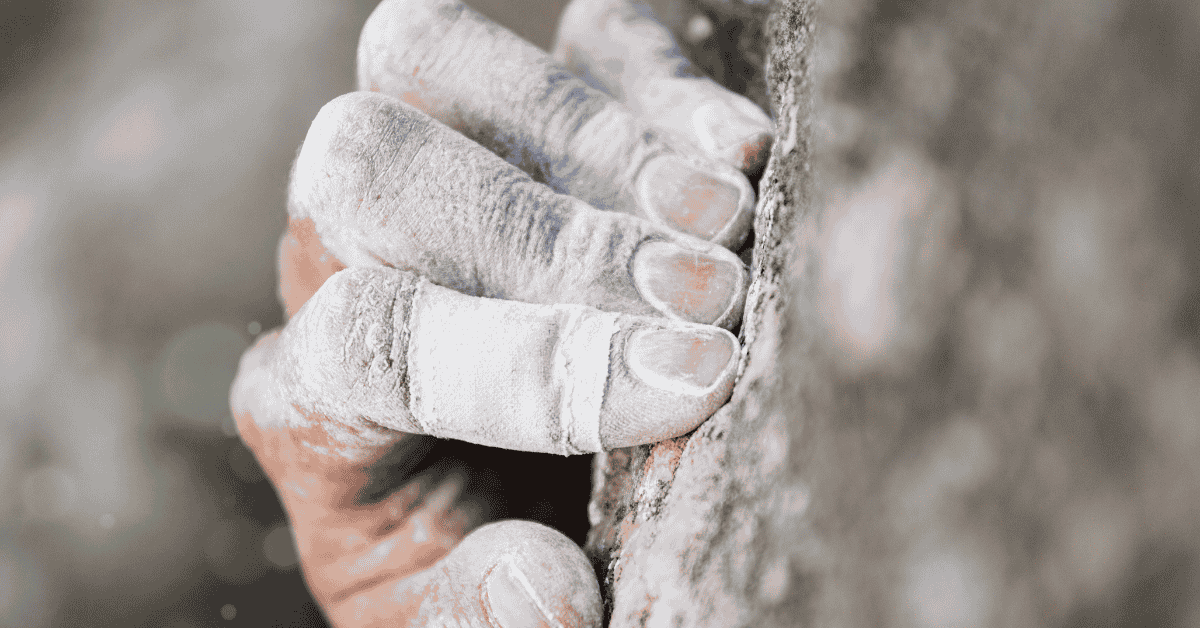
Common climbing finger injuries happen more often than you might think, especially if you’re pushing hard, training regularly, or experimenting with fingertips-only rock climbing. The good news is that most of these injuries, like pulley strains, skin splits, and joint inflammation, can be managed without surgery if you catch them early and treat them right. In this guide, you’ll learn how to recognize the signs of injury, how to treat issues like A2 pulley tweaks or swollen DIP joints, and how to safely return to climbing.
We’ll go over taping methods, rehab tools like resistance bands and rice buckets, and smart ways to modify your training. You’ll come away knowing what to do, what not to do, and when to stop climbing and see a doctor. This isn’t fluff. It’s a step-by-step breakdown designed to help you keep climbing, pain-free and stronger than before.
1. Pulley Strains and Tears
A2 pulley injuries are among the most common climbing finger injuries, and they tend to sneak up on you when you least expect it. These injuries happen when excessive force is applied to the flexor tendons, especially when you’re crimping. It could be that moment when you slip and your body reacts by tightening your grip to save yourself. The result? The A2 pulley can partially or completely tear, with the tendon pulling away from the bone. This type of injury compromises the movement at the DIP and PIP joints, making it harder to grip or hold on, which isn’t ideal if you’re trying to climb with intensity.
How to Avoid A2 Pulley Strains and Tears
To avoid this dreaded injury, it’s essential to prepare your fingers before the climb. You can do this with the TheraBand FlexBar or Gyro Ball. These tools activate your fingers, getting them ready for the tension ahead. Another key step is to apply some Finger Tape or Metolius Climbing Tape to offer extra support during high-intensity climbs. Finally, strengthening your fingers gradually using a Tension Block or Lattice Rung will build resistance over time, which means less risk of injury in the long run.
How to Treat A2 Pulley Strains and Tears
If the damage is already done, treating the injury properly is just as important. First, reduce the swelling with a Finger Ice Pack. Ice is your friend when it comes to minimizing inflammation. Once you’ve got the swelling down, you can protect the injured area using the H-tape method with Leukotape P. This will provide support while the pulley heals. Lastly, incorporate some light resistance work with the TheraBand Hand Xtrainer to rebuild your finger strength safely. Slow and steady wins the race here—your fingers need time to bounce back.
2. Tendonitis (Flexor Tendon Inflammation)

Tendonitis, or more specifically tenosynovitis, occurs when the synovium surrounding the finger flexor tendons becomes inflamed. This is often the result of overuse. Many climbers experience this as they continuously stress their tendons while gripping, crimping, or pulling themselves up on holds.
The main culprits are the flexor digitorum superficialis (FDS) and flexor digitorum profundus (FDP). These are the two primary muscles responsible for bending your fingers. When these muscles are overloaded, the inflammation can cause pain, stiffness, and swelling. You probably don’t even realize how bad it is until you try to make a fist and your finger says, “Nope, not today.”
How to Avoid Tendonitis
To avoid tendonitis, use a Theragun Mini or RAD Roller Forearm Kit to reduce muscle tightness and increase blood flow. It’s also essential to strengthen the antagonist muscles to balance out the constant flexing. Tools like the Gripmaster Pro Hand Exerciser or IronMind Expand-Your-Hand Bands are great for building these muscles.
Use a Crossover Symmetry Shoulder & Arm System to stretch your forearms and keep them flexible. The idea is to stay ahead of the game and prevent your tendons from reaching that breaking point.
How to Treat Tendonitis
If you’re already feeling the pinch of tendonitis, don’t ignore it. You’ll need to limit stress on your tendons while they recover. A Mueller Wrist Wrap or Futuro Performance Wrap can help with this.
To promote healing, applying heat using a Sunbeam Heating Pad or even a Paraffin Wax Bath can improve circulation and ease the pain. Once the worst of the pain is gone, start with rehab exercises. The Lattice Training Heavyroller Forearm Tool is perfect for controlled, gradual strengthening.
Remember, recovery is a slow burn. You’re not going to climb your hardest tomorrow, and that’s okay. Tendonitis is one of those common climbing finger injuries you’ll want to treat with care.
3. Collateral Ligament Sprains

Collateral ligament sprains are common climbing finger injuries that often happen when you’re pushing your fingers a bit too far. These ligaments, which run along the sides of your fingers, can take a hit when excessive lateral forces are applied, think of crack climbing, navigating side pulls, or executing a gaston.
Even those quick, dynamic movements that pull you side to side can leave your ligaments straining. It’s in these moments, when your fingers twist or stretch in awkward directions, that the collateral ligaments are most at risk.
How to Avoid Collateral Ligament Sprains
The first step in preventing collateral ligament sprains is maintaining solid finger stability. RockTape Kinesiology Tape can provide extra lateral support when your fingers are under stress. Another great way to avoid injury is controlled loading. Using a Beastmaker 1000 will allow you to gradually build strength without overwhelming your ligaments. Additionally, incorporating exercises with a TRX Suspension Trainer will improve your finger stability by focusing on overall body control.
How to Treat Collateral Ligament Sprains
So, you’ve sprained a collateral ligament? Don’t stress, it happens to the best of us. The key to recovery is limiting unnecessary side-to-side movement. You can do this with Leukotape K by taping your finger in a buddy-taping style. This reduces lateral strain without fully restricting your finger.
To get your mobility back, use Yoga Tune Up Therapy Balls to perform hand mobility drills. This will help your fingers regain flexibility. As your injury heals, introduce progressive resistance exercises with a TheraBand FlexBar to rebuild strength safely.
4. Joint Capsulitis (Inflammation of Finger Joints)
Joint capsulitis feels like your knuckles are quietly protesting each time you try to close your fist. It’s not the sharp stab of a pulley tear or the electric twinge of a nerve issue. It’s duller. Slower. More persistent.
This inflammation usually shows up when you keep climbing harder and longer than your fingers are ready for. The connective tissue around your finger joints starts to swell. Your range of motion shrinks. Your joints ache not during that one big dyno, but during the warm-up the next day.
How to Avoid Joint Capsulitis
Your fingers, like the rest of your body, are not machines. Hydration helps. Use something like Liquid IV Hydration Multiplier, especially if you tend to lose track of water between sessions.
Massage the base of your fingers with the Rolflex Arm & Leg Massager Roller. It’s uncomfortable in that way good things often are. You can also build finger endurance more gently by using a Tension Whetstone Board.
How to Treat Joint Capsulitis
Recovery asks for patience. The Recoup Fitness Cryosphere Ice Massage Ball and the Theragun Wave Roller offer a simple way to reduce swelling and give your joints a break. You can rotate between hot and cold if that’s your thing, or stick to one—whichever feels more soothing.
For cartilage support, some climbers add NOW Glucosamine & Chondroitin into their recovery stack. And when your fingers are ready to move again, Gaiam Hand Therapy Balls can help you regain range of motion without pushing too fast.
Out of all the common climbing finger injuries, joint capsulitis might be the most stubborn. But it also teaches you to slow down and pay attention to the parts of your body you usually take for granted.
5. Bone Bruises and Stress Fractures
In climbing, bone bruises and stress fractures tend to show up when repetition outruns recovery. Bruises start when your bones get knocked around enough to damage blood vessels in the bone and surrounding tissue. Stress fractures happen when the micro-damage stacks up faster than your body can repair it. What begins as stiffness or tenderness can progress to sharp, localized pain during movement, especially in the feet, hands, and fingers.
These injuries are some of the more overlooked among the common climbing finger injuries. Overuse is often part of the equation. So is climbing hard, climbing often, and climbing without enough rest.
Young climbers, still developing their bones, are especially at risk. Poor technique adds pressure to the same spots over and over. And bouldering—with its short, powerful moves and frequent falls—can take a toll on smaller bones. You’ll often see these injuries in the metatarsals, hamate, and phalanges.
How to Avoid Bone Bruises and Stress Fractures
Progress slowly, even if your ambition wants to sprint. Warm-ups and cool-downs are underrated, but your future self will appreciate the consistency. Focus on strength and conditioning. Muscles can absorb force your bones would rather avoid. Learn technique. Take rest seriously. Track your load. Train smart using Pinch Grip and Farmer Crimp Grip Strength Training Hangboard. Get enough calcium. Garden of Life Plant Calcium can help if your diet falls short.
How to Treat Bone Bruises and Stress Fractures
Start with rest. A lot of it. For bone bruises, go with RICE: rest, ice, compression, elevation. For stress fractures, immobilize if needed. Use the Futuro Performance Stabilizing Brace to protect the injury. Biofreeze Gel can dull the ache. When it’s safe, rebuild strength with the PowerFingers Strength Trainer.
Proper Training with a Hangboard
Hangboarding is one of the smartest ways you can protect yourself from common climbing finger injuries. It trains your finger flexor tendons and the little muscles that do a lot of heavy lifting. More than that, it allows you to load the finger pulley system in a controlled way. This technique builds your tissue’s tolerance.
If you’re just getting into hangboarding, start with tools that won’t bully your fingers. Metolius Rock Rings and the Trango Rock Prodigy give you enough variety without pushing you into injury territory. If you’ve been climbing for a while and know where your limits live, the Beastmaker 2000 and Tension Grindstone bring more precision to your finger training.
Before you even think about hanging, warm your fingers. Never hangboard with cold fingers. Cold tissue tears faster. While you’re at it, track your hang times, rest intervals, and progress.
Hangboarding can feel repetitive and strange. But it works. It trains the exact systems that climbing wears down. And the more you train with intention, the more likely you are to keep climbing.
Conclusion
If you climb long enough, you will feel something tweak, snap, or throb. What matters is how you respond. A smart mix of prevention, awareness, and recovery can spare you from turning common climbing finger injuries into long-term problems.
Tape helps. So do therapy tools, supplements, and a hangboard. You are not fragile; you are adaptable. But you are also not invincible. Train hard, recover harder, and keep your fingers strong enough to hold on to whatever wall you face next.
You May also Like
Improve Your Performance With the Best Workouts for Climbers
Improve your climbing by following the best workouts for climbers. These workouts target exactly wha
 A M
A M 
Practical 12-Week Climbing Training Plan for the Best Results
If you’re looking for a structured way to get stronger, climb better, and stay injury-free, this 1
A M 
Boost Focus and Confidence with Mental Training for Climbers
Mental training for climbers helps you stay focused, calm, and confident in moments of stress, chall
A M