
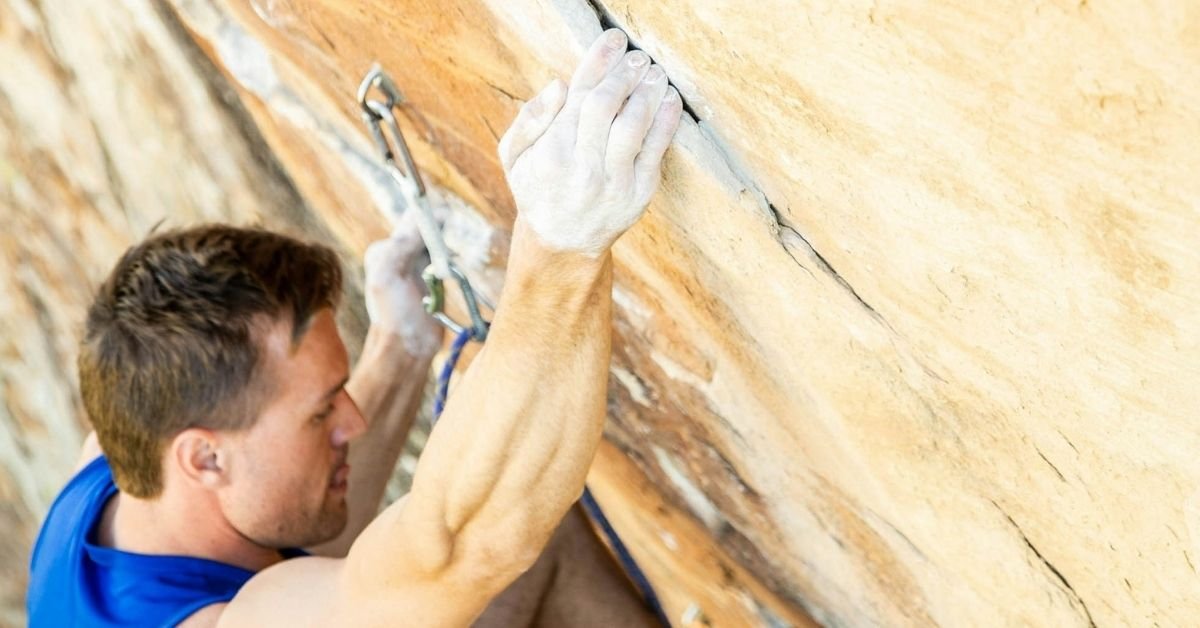
Fingertips-only rock climbing, or crimping, is one of the most demanding techniques in the sport. It requires you to use the tips of your fingers to grip small, often sharp edges or “crimps” on the climbing wall.
In this guide, we’ll break down the fundamentals of fingertips-only rock climbing, helping you build the strength and endurance needed to conquer these challenges. You’ll also learn how to refine your technique so you can climb with better control and efficiency. Let’s take your climbing skills to the next level.
What are the Challenges of Fingertips-Only Rock-Climbing?
Fingertips-only rock climbing is a technique that pushes both your body and mind to their limits. What makes it so difficult, and what challenges can you expect to face along the way?
1. Precision and Strength
The holds you’re using are small and sharp, requiring precise finger control to maintain your grip. Unlike larger holds, which let you use your whole hand, crimping forces you to rely on just the tips of your fingers. This demands a high level of skill. The real challenge is the strength required to support your body weight on such small contact points, pushing your finger muscles to their limits.
2. Finger Weakness and Grip Fatigue
You’re gripping tiny holds and putting a ridiculous amount of pressure on the muscles and tendons in your hands. It’s exhausting, and if you’re not careful, it can leave you injured. If you want to stay on the wall without crumbling under the strain, you’ll have to build your endurance, your strength, and your skill.
3. Skin Discomforts
When you crimp, you’re bound to feel the sting. Your fingertips will burn, calluses will form, and maybe you’ll tear some skin on those jagged, unforgiving rocks. It’s not a pleasant feeling, but it’s part of the deal. It’s how your hands start to adapt to the technique. Over time, you’ll find that your hands get better at it, even if they never really get used to the pain.
4. Wear and Tear on Tendons and Joints
It’s easy to push your tendons, ligaments, and finger joints too far. But that’s how tendonitis, ligament tears, and joint pain sneak up on you. Don’t let impatience be the thing that breaks you. Recovery isn’t optional;it’s part of the deal. Give those fingers time to rest, or you’ll be sidelined for longer than you’d like.
5. Mental Strength
Mental toughness isn’t just about gritting your teeth through the pain. When your fingers are tired, it’s harder to stay focused. You may want to quit when your muscles feel like they can’t take any more, but you have to push through. It demands more than just muscle or willpower. But dig deep enough, and you’ll find strength you didn’t know you had.
6. Thriving Under Stress
To thrive under stress, you need to stay calm and confident. For fingertips-only rock climbing, it’s especially important to stay aware of your body and surroundings. Focus on your grip and how each finger feels. Climbing with supportive partners also makes a difference. Their encouragement can help you push through the hard moments.
How to Improve Fingertip Strength and Performance

Banking entirely on strength can backfire. Why? Because it’s easy to burn out. Strength can get you so far, but it’s a technique that lets you go the distance. By mastering your form, you’ll climb longer with less strain on your fingers and tendons. In this guide, we’ll show you how to improve your strength and technique for better performance.
Finger Anatomy and Strength Development
Fingertips-only rock climbing demands strength from the tendons and muscles that hold those tiny, precise grips in place. You’ll need to focus on strengthening the flexor tendons, lumbrical muscles, and finger flexors. Yes, dead hangs and finger rolls are your best friends here, but don’t expect a quick fix.
Tendons are notoriously slow to adapt, so prepare for the long haul. We’re talking weeks, maybe months, of steady training to keep pace with the crimping demands. Patience is your biggest ally, and proper techniques, training, and injury prevention are going to pay off.
Essential Grip Techniques
In fingertips-only rock climbing, mastering grip techniques is very important. You need to hold on to the tough edges without hurting your fingers. Each grip works a little differently, so learning when to use which one is critical.
The full crimp is best for very small holds, but it can hurt your joints, so use it carefully. The half crimp is better for balance, giving power without hurting your fingers as much. The open grip is great for easy climbs when you want to save energy.
Use the pinch grip when the hold needs precision. The friction grip (or palming) works well on sloped, smooth surfaces. Lastly, the 3-finger drag is useful when your elbows are lower than the hold.
Strength Training for Fingertips-Only Rock Climbing
Your fingers will quit before your head does, and if you’ve ever tried clinging to a dime-sized edge, you already know this. In fingertips-only rock climbing, strength is the difference between staying on the wall and peeling off mid-move.
You can’t expect to climb with just sheer willpower, not when your fingers are telling you to quit. Hangboarding, campus board throws, rice bucket drills, and finger curls are how you train your fingers to hold on when they’re screaming to let go. It’s about building strength through the pain, getting used to the trembling, and fighting gravity.
Related: Beginner’s Complete Guide To Finger Strength Training For Climbing
Injury Prevention and Recovery
Fingertips-only rock climbing has a way of humbling you. One day you’re sticking holds like a machine, the next you’re nursing a nagging tweak that started with a sharp pull and a bad decision. You are loading your fingers with more than they signed up for. Injuries come fast when ego climbs faster than your tendons.
To stay on the wall, you need patience and precision. Good technique isn’t about looking graceful, it’s about keeping your hands out of trouble. Start slow. Build real strength. Pay attention to how your fingers land. Because the wrong grip doesn’t just feel off. It breaks things.
If you do experience an injury, proper recovery methods are essential for getting back to climbing quickly and safely. Rest is your first priority; don’t push through the pain. Ice is incredibly helpful in the first 24 hours to reduce swelling. Apply ice for 15-20 minutes at a time to the affected area.
Related: Practical Ways to Handle Common Climbing Finger Injuries
Common Mistakes in Fingertips-Only Rock Climbing
A common mistake that leads to pulley injuries is skipping the warm-up and overtraining. Jumping into intense climbing or hangboarding without building strength gradually puts unnecessary stress on your fingers. Poor hand positioning also contributes to injuries.
What are the Mental and Technical Skills for Fingertips-Only Rock Climbing?
Fingertips-only rock climbing requires mental sharpness and technical skill to tackle the smallest holds with precision. This discipline demands strategy, resilience, and body awareness.
Mental Skills
As you cling to tiny holds, doubt sneaks in. You start questioning every move. One slip, and it’s over. Fear creeps up, but that’s part of it. Doubt is the real enemy, slipping into your thoughts with every shift of weight. You’ll feel the fear. It’s inevitable. But the trick isn’t avoiding it. It’s learning to breathe through it, to move past the hesitation that can send you crashing. Falling? That’s just part of the deal. What matters is getting back up. Sometimes, taking a step back gives you the clarity you need to keep climbing.
Technical Skills
Fingertips-only rock climbing isn’t for the faint of heart. Each move demands a strange combination of focus and sheer will. Your fingers, barely holding on, will beg you for mercy as they grip tiny holds, but you push on. You learn to master the grips, full crimp, open hand, pinch. But knowing when to switch between them is what separates the climbers from the dreamers.
Overgripping will burn you out, so you learn to stay calm, conserve energy, and make every move count. Keeping your body close to the wall eases the strain on your fingers. And, yes, rest. Taking breaks on small holds is your secret weapon.
What are Climbing Gear Essentials for Fingertips-Only Rock Climbing?
When you climb, your gear does keeps you safe and helps you focus and perform. Without the right equipment, you’re not just risking your safety; you’re fighting your own body. Here’s what you need:
- Climbing shoes. Fit snug, especially around the toes, so you can feel the rock and control those tiny holds.
- Harness. Safety first, but make sure it’s comfy enough to wear for hours.
- Chalk. Keeps your hands dry and your grip tight when you’re starting to slip.
- Helmet. Especially outdoors. Protect your head, no questions.
- Rope & belay device. Your lifeline for a safe fall.
- Carabiners & quickdraws. Keep everything locked down and secure.
- Finger tape. Protects from cuts and stress on those long climbs.
- Bouldering pad. Gives you confidence to push your limits.
Related: The Best Quality Rock Climbing Gear List for Beginners
Where to Start Practicing for Fingertips-Only Rock Climbing
Where you train matters. The space you carve out for yourself, whether it’s an indoor gym or the wild outdoors, sets the pace for how fast you’ll see progress. The right setup, the right holds, the right tools, and the right focus. But how do you even begin? How do you go from flailing on the wall to owning it with confidence?
Best Indoor Training Methods for Fingertips-Only Rock Climbing
If you’re starting out with fingertips-only rock climbing or trying to get better, indoor training is where you’ll want to begin.
The hangboard—harsh, but effective—will test your fingers in ways you didn’t think were possible. You’ll start with easier holds, your confidence building with each try. But soon, those holds get smaller. It’s a slow, painful process, but improvement comes in its own time.
At the bouldering wall, focus on your fingers, small holds, and practice those finger curls to keep getting stronger.
Incorporating Small-Hold Climbing in Bouldering Problems
Bouldering is one of the best ways to train for those punishing fingertip holds. Forget sticking to the basics; take control by tweaking the routes. Swap out jugs for crimps or pinches, and pick problems that keep you on tiny slopers. It’s all about using just your fingertips, not your whole hand.
As you train, you’ll feel your fingers getting stronger, and moving between holds will start to feel smoother. Push yourself with smaller crimps and thinner slopers, and don’t forget to throw in some unpredictable, rough conditions to make it feel more like real outdoor climbing. You’ll start preparing for the real deal.
Best Outdoor Routes for Finger-Intensive Climbing
When you finally take your training outdoors, you’ll want to find routes that really challenge your fingers. Outdoors, you’ll face small, awkward holds that force you to rely on your fingertips. Crack climbing forces you to look for those tight cracks where you must jam your fingers into tiny spaces. Every move demands both strength and stability, and you’ll soon realize just how much your fingers can handle.
Slab climbing isn’t any easier. With its small holds and slopers, you’ll have to focus on every inch of body positioning, ensuring you don’t slip. Then, on sport routes, especially in places like Joshua Tree or Red Rock Canyon, you’ll meet crimps so small that you’ll have no choice but to trust your fingertips completely. It’s brutal, exhausting, but oddly satisfying.
Mastering Advanced Techniques in Fingertips-Only Rock Climbing
Fingertips-only rock climbing is a strange mix of stubbornness and strategy. To get better, it’s about refining your technique and learning the ropes, literally and figuratively. There’s no magic secret, just slow, careful progress. You need patience, and you’ll have to be willing to get it wrong a few times. Smart training helps, of course, but you’ll also need to listen to those who’ve done it. You can’t rush the process, but you can definitely push your limits.
Tracking Strength Gains and Grip Endurance
You can’t really measure progress if you’re not paying attention. Without tracking your growth, it’s easy to forget how far you’ve come. Strength and endurance are the backbone of it all. Those are the things you need to focus on first.
Take hangboarding, for example. Start with the easy holds, then slowly, painfully, work your way down to the smaller ones. It’s not about doing more climbs; it’s about holding on longer, holding on better. Track how long you can cling to the tiny edges or how many harder routes you can finish. When you find yourself holding on for a few more seconds or finishing a climb that once seemed impossible, you’ll know you’re getting somewhere.
Adding Movement Variety
Static movements will only take you so far. To push yourself, you need to dive into dynamic moves, reaching, jumping, and shifting your weight in the blink of an eye. But here’s the kicker: you still have to keep that finger strength steady.
Start with controlled dynamic moves. Reach fast, but make sure your grip doesn’t slip. When you’re comfortable with static holds, test your finger strength in motion. Shift your weight, stretch for small holds, and pull yourself up. With practice, it will feel more natural, and you’ll finally hit your stride, ready for the next challenge.
Mastering Techniques from Experienced Climbers
Experienced climbers make it look effortless, but we all know it’s not. The way they move fluidly and gracefully is a dead giveaway that there’s something you’re missing. Is it their grip technique? How do they conserve energy in ways you haven’t?
You’ve probably wondered this at some point. We’ve all been there, standing at the base, watching someone glide up a wall while you’re just trying to stay upright. But you’re allowed to ask for guidance. Sometimes, all you’re missing is a small adjustment in your finger placement, or shifting your body weight. The right advice at the right moment can make you feel like you’re not just climbing a wall, but finally conquering it.
Takeaway Message
At first, you didn’t think you could trust those tiny holds. But now, you’re lifting your whole body on them. But improvement doesn’t happen overnight. It requires patience and grit. And eventually, you’ll realize that the holds that once were impossible now feel like a natural part of the climb.
You May also Like
Practical Ways to Handle Common Climbing Finger Injuries
Common climbing finger injuries happen more often than you might think, especially if you’re pushi
 A M
A M 
Boost Focus and Confidence with Mental Training for Climbers
Mental training for climbers helps you stay focused, calm, and confident in moments of stress, chall
A M 
Finger Strength Training: A 6-Week Program for Intermediate Climbers
Learn techniques from professional climbers on managing fear and maintaining focus when you're way above your last pad. Learn
Alex Honnold